PDG PROmote 2026+
- 4.3
- Rating
- 10.00K
- Installs
- $34.99
- Price

 Analysis by App-foxy
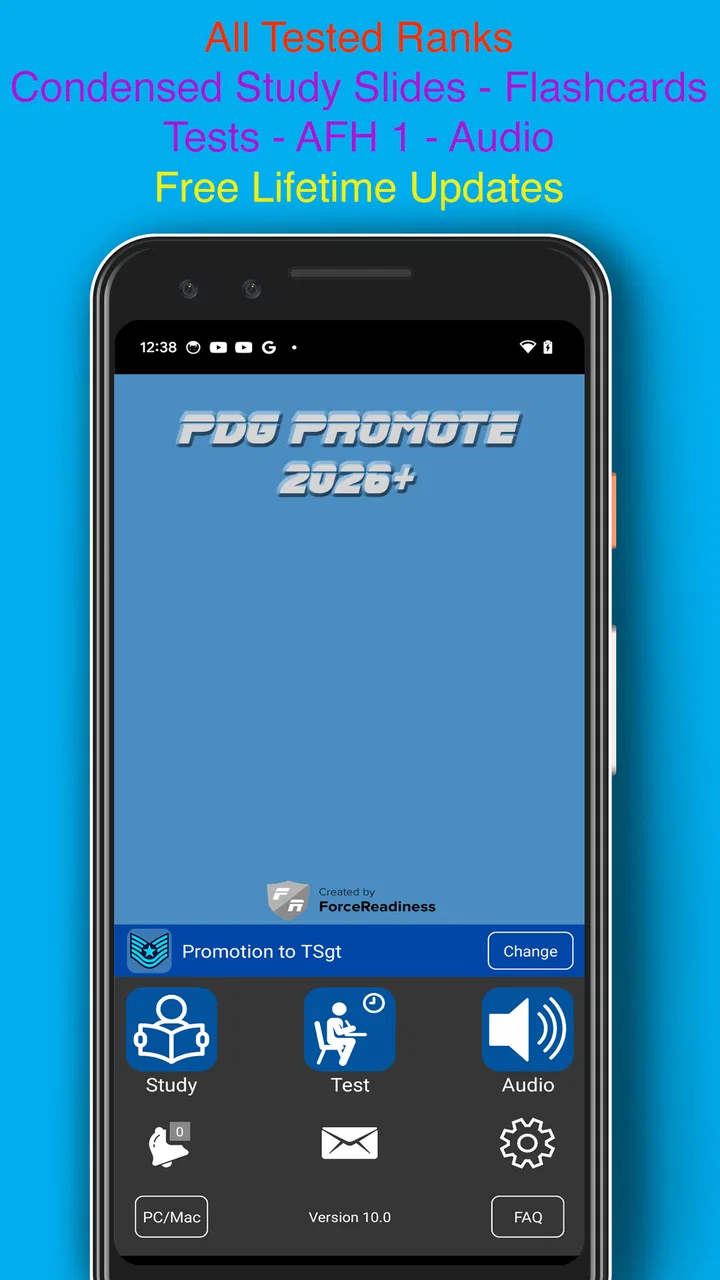
Preparing for an Air Force promotion exam can feel less like ordinary studying and more like trying to organize a large amount of material around an already busy schedule. PDG PROmote is an education app built specifically for Airmen working toward promotion to Staff Sergeant or Technical Sergeant. I found its main appeal in that narrow focus: it is not trying to be a general study platform, a news reader, or a broad military reference library. It is intended to become a dedicated study companion for the Professional Development Guide material that promotion candidates need to review.
The app is developed by ForceReadiness.com and currently carries a 4.3 average from over fifty ratings, with more than forty written reviews. It has passed the ten-thousand-install mark, which gives it a modest but recognizable presence among specialized Air Force study tools. The price is $34.99, so I would not treat it as a casual download. It needs to earn a regular place in your routine, especially if you are comparing it with free notes, printed material, or general-purpose flashcard apps.
My overall impression is that this is most useful when you already have a promotion goal and want a focused way to keep the material in front of you. It makes more sense for an Airman who is ready to study consistently than for someone only browsing for free educational apps. The content rating is Everyone, and the app runs on Android nine or later. It was released on January 15, 2025, and the current version is 11.1, details that matter if you are checking device compatibility before paying for it.
You May Also Like

 Pandora - Music & Podcasts
Pandora’s Music Is Easy to Start, but Harder to Recover
Pandora’s strength is its low-effort path from a seed to a station. Its weak spot is how much confidence it asks you to place in connection, setup, and quiet recovery.

 8 Ball Pool
 Is Built on Rivalries, Rematches, and Routine
A close look at the rivalries, rematches, shared routines, and unanswered safety questions that turn a quick pool match into a persistent mobile community.

 Samsung Music
’s Quiet Strength Is Playing What You Already Own
Its reach comes less from spectacle than from dependable access to a personal library. That simplicity is both the app’s strongest retention engine and its ceiling.

 AccuWeather: Weather Radar
AccuWeather Review: A Quick, Clear Forecast for Everyday Decisions
For everyday plans, the best forecast is the one you can understand quickly. AccuWeather makes rain timing, radar, and local conditions easy to act on, with a few trade-offs.

 Hill Climb Racing
Why Hill Climb Racing Still Turns Crashes Into One More Run
A tiny car, a bumpy hill and one more upgrade: Hill Climb Racing keeps resurfacing because its simple chaos makes every near-miss feel personal.

 AliExpress - Shopping App
AliExpress Makes Global Shopping Feel Personal, but Shoppers Bear the Risk
AliExpress turns a global marketplace into a pocket-sized discovery engine. Its reach is useful, its shopping loop compelling, and its trade-offs easy to miss.
More From Our News Desk
View All News


What to expect from a focused promotion study app
The first thing I would set straight is what this app is—and what it is not. It is not a replacement for understanding your official study requirements, keeping track of local guidance, or asking your leadership which material applies to your promotion cycle. I see it as a study aid that helps turn review time into a repeatable habit. That distinction is important because no quiz app can decide what your unit expects you to know or guarantee an exam result.
The store summary presents it as a go-to app for Airmen studying for SSgt and TSgt promotion. In practical terms, that means the audience is already fairly specific. A new recruit looking for general Air Force education may find the focus too narrow. An Airman who is actively preparing for one of those promotion steps is much more likely to understand the value of having a dedicated tool rather than assembling a study system from scattered documents and generic revision apps.
I would approach the experience as a series of short study visits rather than one giant session. That mindset helps because promotion preparation is usually easier when you revisit material repeatedly. A useful routine might be a few questions during a break, a longer review after work, and a final recap of mistakes later in the day. The app becomes more valuable when it is used to identify weak areas, not merely when it is opened to confirm answers you already know.
The most important expectation is steady repetition, not instant mastery. A specialized app can make studying more convenient, but it cannot remove the need to read carefully, remember context, and return to difficult topics. If you tend to tap through questions quickly without reviewing errors, you may get less from the purchase than someone who treats every incorrect answer as a prompt to investigate and revisit the subject.
Compared with ordinary flashcard apps, the advantage here is the Air Force promotion context. A general flashcard tool gives you the responsibility of finding, formatting, and maintaining the material yourself. That can be flexible, but it also creates work before studying even begins. Compared with printed notes, an app is easier to carry and better suited to brief sessions. The trade-off is that you are relying on a digital study experience rather than a document you can annotate freely or keep beside you without a device.
Who will get the most from it
I would recommend taking a serious look at it if you are an Airman with a defined SSgt or TSgt promotion target, limited study windows, and a preference for learning through repeated questions. It is also a sensible choice for someone who has already gathered the required reading but struggles to turn that reading into active recall. The app gives your preparation a central place instead of forcing you to switch between notes, browser tabs, and homemade quizzes.
I would be more cautious if you are not sure which promotion material applies to you, if you strongly prefer free resources, or if your learning style depends on detailed written explanations rather than question-based review. The $34.99 cost is easier to justify when you will use the app throughout a real preparation period. It is harder to justify as a one-week experiment or as a backup for material you never plan to revisit.
First setup: making the first session useful
After installing it, I would begin by clarifying my own goal before tapping through the app. Decide whether you are preparing for SSgt or TSgt, estimate how much time you can realistically study each week, and keep the official material you are expected to use nearby. That preparation prevents a common mistake: treating the app as the only authority instead of using it alongside the requirements that govern your own promotion process.
The setup itself should be approached deliberately rather than as a race to start answering. Look for the area that matches your promotion path, then spend a few minutes learning how the app presents questions, answers, progress, and review material. Even when an interface feels straightforward, understanding the difference between a new question, a missed question, and a repeated question can save time later.
One practical tip is to create a simple external study note during your first few sessions. I would record the topics or question types that repeatedly slow me down, without copying an entire answer bank. That note gives me a separate map of weak areas and stops me from confusing familiarity with knowledge. Seeing the same question twice can make an answer feel obvious even when I have not retained the underlying idea.
Another useful habit is to avoid beginning with the longest session you can possibly manage. Start with a manageable block and finish while you still know what you reviewed. The goal is to establish a routine that survives duty changes, fatigue, and unexpected interruptions. A study tool becomes much more useful when it is opened regularly, and regular use is easier to build from a realistic starting point than from an ambitious schedule that collapses after a few days.
The app’s minimum requirement is Android nine, so most users with a reasonably current Android phone should be able to check compatibility before purchasing. I would still verify the device requirement in the relevant app store and make sure the phone you actually carry is the one you intend to use. If you switch between devices, keeping your study routine consistent may be more important than choosing the newest hardware.
A realistic first-day routine
For a first session, I would spend a few minutes identifying the correct promotion track, complete a short set of questions, and then stop to examine every mistake. I would not judge the app by the first score. An initial result is more useful as a baseline than as a verdict on readiness. The meaningful outcome is knowing which subjects deserve attention and whether the question format helps you stay engaged.
After that first set, I would write down three things: what felt easy, what required guessing, and what I could not explain in my own words. The third item is especially important. Correctly selecting an answer by recognition is not the same as being able to recall the concept later. This small distinction turns the app from a tapping exercise into a more honest diagnostic tool.
If the first session feels too easy, resist the temptation to conclude that the entire exam will be easy. Familiar questions can reflect previous exposure rather than complete preparation. If it feels difficult, do not assume the purchase was a mistake. Difficulty can reveal exactly where a structured review tool earns its place, provided you are willing to return to those areas and connect them with the underlying study material.
Finding the first meaningful success
For me, the first real success with a study app is not achieving a perfect early score. It is completing a session, identifying a weakness, reviewing it, and then answering a related question more confidently later. That cycle is the behavior I would encourage new users to look for. It shows that the app is helping you manage preparation rather than simply giving you another screen to fill with answers.
A good everyday scenario would be an Airman who has a short break during a busy day but does not have enough time to read a full chapter. Instead of scrolling through unrelated material, the user opens the app, works through a focused review, and notes the questions that caused hesitation. Later, perhaps after work, the user returns to those weak points with the official study material. The app provides the prompt; the deeper reading provides the context.
This two-stage workflow is one of the strongest ways to use a question-based tool. First, use the app to expose uncertainty. Second, use the source material to understand why the answer is correct. Third, return to the app to see whether the knowledge holds up without looking at the explanation first. That approach is more demanding than memorizing answer patterns, but it is also less likely to leave you confident only because the screen looks familiar.
I would also separate learning sessions from checking sessions. During a learning session, pause after difficult questions and investigate them. During a checking session, answer without interrupting yourself, then review the results afterward. Mixing those modes can make it hard to tell whether you are building knowledge or merely measuring it. Keeping them distinct gives you a clearer picture of progress.
Another non-obvious advantage of a dedicated promotion app is reduced preparation overhead. With a generic flashcard service, you may spend significant time deciding how to phrase cards, which material to include, and how to organize categories. That flexibility is valuable for some learners, but it can become procrastination disguised as preparation. A ready-made tool lets you spend more of your limited time answering and reviewing, though you give up some control over how the material is arranged.
How to use mistakes without burning out
I would not repeat every missed question immediately until the answer feels familiar. That can create a false sense of improvement. Instead, mark the concept in your notes, study the relevant material away from the question, and return later. Spacing the review makes it harder for short-term memory to hide gaps and gives you a more honest test of recall.
It also helps to set a stopping rule. If concentration drops and you are guessing repeatedly, continuing may produce a long session but poor learning. A short, attentive review is more useful than an exhausted attempt to reach an arbitrary target. This is particularly relevant for Airmen balancing preparation with duty, family, and sleep. The app can fit into a demanding schedule, but it cannot make fatigue disappear.
For users who study with a partner, I would use the app as a source of discussion rather than turning it into a competition. One person can answer while the other explains why the choice makes sense, then switch roles. This exposes shallow memorization and makes confusing wording easier to notice. It also gives the study session a clear purpose beyond comparing scores.
Common confusion and honest limitations
The most likely confusion is assuming that a correct answer automatically proves full readiness. It does not. Promotion preparation involves remembering information, understanding professional context, and following the material relevant to your own situation. I would use this app to reinforce study, not to replace official guidance or the source documents you are expected to know.
A second point of friction is the price. At $34.99, this is a paid commitment in a category where users can find free notes, community-made quizzes, and general flashcard tools. Those alternatives may be enough for someone who is highly organized and willing to build a study system from scratch. The paid option makes more sense when convenience, focus, and reduced setup work are worth the cost to you.
The app’s narrow audience can also be a limitation. If your goal is broad military education, career planning, or learning outside SSgt and TSgt promotion preparation, you may outgrow it quickly or find that it does not match your needs. Its strength is specialization, and specialization naturally means fewer reasons to open it once your particular study period ends.
I would also avoid treating the app’s rating as a guarantee that it will suit every learner. A 4.3 average from over fifty ratings suggests that many users find value in it, but ratings cannot tell me whether the question style matches my memory habits, whether the pacing feels right, or whether I will use it consistently. Those are personal factors, and they matter more than a store score when deciding whether a study tool will earn its place on your phone.
Another practical concern is source awareness. Promotion material can be sensitive to the requirements of a particular cycle or role, so I would compare what I study in the app with the official resources assigned to me. If anything appears inconsistent, I would resolve that before relying on it. This is not a criticism unique to this product; it is a sensible safeguard whenever an app condenses professional study material into quick questions.
When another option may be better
A general flashcard app may be better for someone who wants complete control over wording, examples, and categories. It can also suit a learner who already has carefully prepared cards and wants to keep using the same system for several subjects. The downside is the time required to create and maintain those cards, along with the risk of building a collection that tests recognition without teaching understanding.
Printed study material may be the better choice for someone who highlights, writes notes in margins, or studies in places where phone use is distracting. A book or document can provide broader context than a quick question. I would pair that approach with this app rather than assuming one must replace the other: use the printed material for depth and the app for retrieval practice.
Free online resources may suit an Airman with a very limited budget, but quality and organization can vary. The convenience of a dedicated product is easier to appreciate when you have already wasted time searching for scattered material. On the other hand, if cost is your main concern and you are comfortable organizing your own revision, paying for specialization may not be the right trade-off.
Finally, someone who learns best through instructor-led explanation may need a class, mentor, or study group as the main resource. An app can support that learning, but it is not a substitute for asking questions and discussing difficult concepts with experienced people. I would choose PDG PROmote as a focused practice layer, not as my only form of preparation.
What to do after the first week
Once the novelty wears off, I would review my notes and look for patterns instead of merely chasing a higher score. Are the same subjects causing trouble? Do mistakes happen because I forget terms, misread questions, or fail to understand the context? Each pattern calls for a different response. More repetition may help memory, while source reading or discussion may be necessary when the problem is comprehension.
I would then create a repeating cycle: app practice to find weak points, official material to explain them, and later app practice to check retention. That cycle is more useful than opening the app randomly because every session has a job. It also gives me a way to decide whether the $34.99 purchase is paying off: not through screen time, but through clearer understanding and fewer recurring mistakes.
Keep the sessions varied. Use one visit to work slowly through unfamiliar material, another to test recall without interruptions, and another to revisit questions that previously caused trouble. This prevents the app from becoming a single repetitive task. It also helps reveal whether improvement is genuine or simply the result of remembering the order or wording of familiar prompts.
I would not wait until the final stretch before checking how well the app fits my schedule. If it is awkward to use during short breaks, too easy to ignore, or poorly matched to your preferred learning style, discover that early and adjust. You may need to combine it with a notebook, printed references, or a study partner. The best setup is the one you will actually maintain while still giving the official material the attention it deserves.
My recommendation for first-time users
PDG PROmote is worth considering for Airmen who have a clear SSgt or TSgt promotion objective and want a specialized way to practice regularly. I like its focused purpose, and I think its strongest role is turning spare moments into deliberate recall practice. The app is especially appealing when building quizzes from scratch would take time you would rather spend studying.
I would not recommend buying it casually if you are unsure about your promotion path, expect a complete replacement for official study resources, or prefer learning entirely through long-form reading. The cost deserves a realistic plan for repeated use. Before purchasing, confirm that your Android device meets the minimum requirement of version nine or later and decide how the app will fit alongside your existing material.
My final view is balanced but positive: this is a focused education app with a clear audience, not a universal Air Force learning solution. Its value comes from disciplined use—testing yourself, investigating mistakes, and returning later to confirm what you retained. If that workflow matches the way you prepare, ForceReadiness.com’s app can become a practical part of your promotion routine. If you only want occasional browsing or a completely free study system, the usual alternatives may serve you better.
FAQs for PDG PROmote 2026+
01What is PDG PROmote 2026+ used for?
PDG PROmote 2026+ is designed as a promotional and communication tool for users who need access to PDG-related content, announcements, campaign information, or event resources in one place. Before downloading, check the current app description and screenshots to confirm that its available features match your needs, since content and functions may vary depending on your organization, region, or account permissions.
02Is PDG PROmote 2026+ free to download and use?
The application may be available to download without an upfront charge, but access to certain content or services can depend on an invitation, registered account, organization membership, or specific promotional program. We recommend reviewing the store listing carefully for subscription details, in-app purchases, or access restrictions before installing. Also verify whether your employer, event organizer, or campaign administrator provides the required login information.
03Do I need an account or invitation to use PDG PROmote 2026+?
Many promotional and business-focused applications require users to sign in or receive authorization before they can view all available materials. PDG PROmote 2026+ may work similarly, particularly if it is connected to a private campaign, event, company, or partner program. If you cannot access the app after installation, confirm your credentials, invitation link, or organization code, and contact the relevant administrator rather than repeatedly creating new accounts.
04What permissions does PDG PROmote 2026+ request?
The permissions requested by PDG PROmote 2026+ can depend on the features enabled in the version you install. Promotional apps may request internet access for updated content and notifications, while optional functions could require access to files, the camera, or device notifications. Review each permission when it appears and deny anything unrelated to your intended use. You can later manage permissions through your Android or iOS privacy settings.
05Is PDG PROmote 2026+ compatible with my phone?
Compatibility depends on your device model, operating system version, available storage, and the specific release distributed through Google Play or the App Store. Before downloading, open the official store page and check the listed Android or iOS requirements. Keeping your operating system updated can improve stability, although older devices may still experience slower performance or limited access to newer features included in future app updates.
Pros
- Streamlines planning for PDG PROmote 2026+ activities in one place.
- Useful for keeping event-related information organized and accessible.
- May reduce the need to rely on scattered messages or paper notes.
- Convenient mobile access while attending or preparing for activities.
- Focused design can make the app easier to use for participants.
Cons
- Its usefulness may be limited outside the PDG PROmote 2026+ event.
- Some features could depend on organizer-provided content or updates.
- Users may need notifications enabled to avoid missing important information.
- Event-specific apps can become less useful once the program has ended.
- Compatibility and performance may vary across older Android or iOS devices.

PDG PROmote 2026+
Gallery